
Minolta have always been the third of the big three with Canon and Nikon. But always third. In the end, it all became too much and after combining with Konica, they gave up and sold the rights to their camera designs to Sony, where the Minolta heritage continues.
For some reason, vintage Minoltas seem less popular than other very similar cameras, and despite innovative designs, excellent build and very attractive cameras, they sell for really good prices, especially those less than the top model in each range. Testament to how good they are is that when Leica looked for a Japanese partner to make SLRs for them, they chose Minolta. The first non German Leica SLR, the R3 is heavily based on the Minolta XE-1 and was built by Minolta. The non Macro Minolta 35-70mm f3.5 lens was built on the same line as the equivalent Leica Summicron and most people say it is actually the same lens. Except of course the Minolta sells for a fraction of the price.
In the pre OM-1 days, Minolta dominated the consumer market with their SRT series cameras. Basically this is just the one camera over its long lifetime, with subtle variations in features and modest improvements in design. To the modern user, allowing for deciding if you want a self timer or not, (check carefully if it has one … a sticky self timer can jam up a camera for good), any one from this range is much like another. They are all SRT, then 100, 200, 300 as the years went on and then (e.g.) 101, 102, 103 for extra features, generally. They are big, solid, very well built, have match needle metering in the viewfinder and are excellent cameras, in the mould of the Spotmatic/K Series Pentax. Small and light they are not.
The  XE-1 was the top consumer model of this period and is a fabulous camera. It is quite bulky but so beautifully made. It was called an XE-7 in the USA and just XE in Japan, but they are identical. For such a high end camera, it can be a bargain, but again, not small. A slightly simpler but outwardly identical version was the XE-5.
Then, Minolta brought out the XD-7 (XD-11 in the USA). 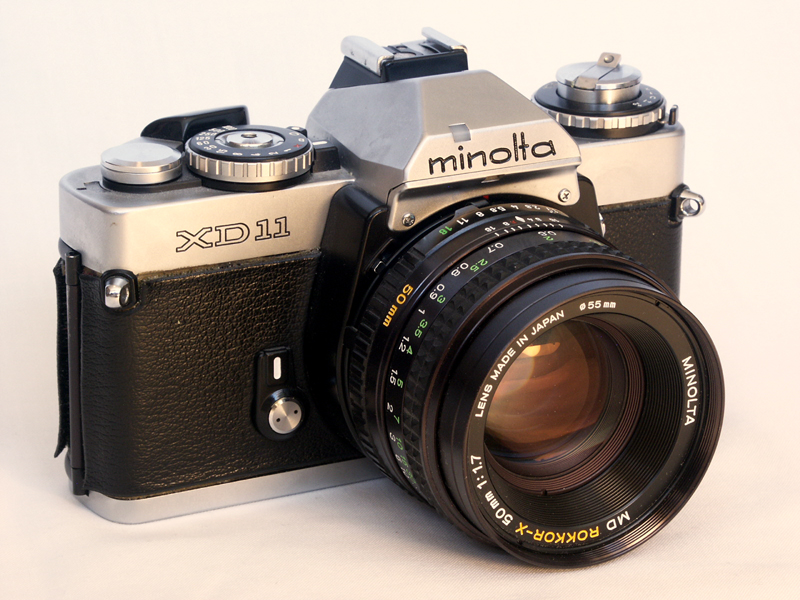 This was the world’s first Camera which had both aperture and shutter priority metering modes together with a micro-processor controlled program override. It is small and light, a gorgeous metal bladed shutter, fully featured in every respect and superbly built (it shares much with the Lieca R4). These are superb cameras that look, feel and sound every bit the high end marvels they are. There was a slightly simpler version called the XD-5 which had less viewfinder information and slightly lower built quality, but otherwise very similar.
At this time, the much cheaper XG series was released. Different names for different markets mean the XG7/XG-e/XG2 is the same camera and was the top model. It is a shutter priority automatic with a basic manual over-ride. The even cheaper XG-1 had less viewfinder information. These two were replaced by the XG-9 and the XG-a respectively. XG-9s are very capable cameras, with much better viewfinders and very nicely made, but not so well known and hence can be very good value indeed. All of the XG series are well made, capable cameras.
From here, Minolta went downmarket, using more plastic and cloth shutters to reduce the costs. However, my personal favourite (and the camera I use as my standard test camera) is the X-700. As you may now expect, there was a simpler X-500 and even simpler X-300 (plus a better made version the X-370). The X-700 has similar features to the XD-7 and is similarly small and light. It handles beautifully and all the controls just work well. I love it. The X-500 is virtually as good and the X-300/370 is a great bargain being a full auto manual camera with OM-10 standard build, looks great and works very well. They sold the designs to Centon, who made an almost identical version in China, these are cheap but very cheerful cameras.
Then, Minolta released the world’s first Auto Focus SLR with the AF inside the camera body, making lenses small and neat. This was the Minolta 7000 with full blocky 80s styling. And thus the world of SLRs changed for good …