In this two part guide I will be looking at what I see as the classic period of film SLR cameras. For me that is the time when all SLRs had through the lens light metering, but before the arrival of auto focus and built in motor drives. I will make another key starting point, which is the arrival of the Olympus OM-1, at which point small and light was shown to be possible in an SLR camera. Also, I will be looking only at consumer cameras, although this is an aribitrary distinction, manufacturers always had a top level range intended for professional photographers, which were characterised by an extraordinary array of interchanegable components and accessories, but also by very high prices and generally big and heavy cameras.
The principal differences between cameras at this stage would be associated with build quality and notably physical size and weight. Then you could choose different levels of functionality, notably whether there was some automation of exposure control. Was it manual only, or did it have an automatic mode (or indeed later on; modes). Then, there could be additional functions like self timers, film memos (ways of remembering which film you had put in), different levels of viewinder information, flash sync and hot shoes for flash mounting, depth of field preview, mirror lock up, viewfinder blinds, but generally, they would not in themselves be reasons to choose a camera.
In part 1 I will look at Olympus, whose OM-1 started the smaller and lighter revolution and Asahi Pentax who competed most closely for the advanced consumer market.
The Olympus OM-1
Olympus had been very successful with its Pen range of half frame cameras (using only half of the film a normal ‘full frame’ camera uses, so you got 48 shots from a 24 exposure film).  With their top level Pen FT and Pen F they had all of the features of an SLR with a wide range of interchangeable lenses, while being small and light to carry.
The SLR format had become the most popular for enthusiast photographers and so they decide to replicate the Pen experience in an SLR. However, it took a little longer than expected and so they rush released an SLR with a range of M42 screw mount lenses to fill the gap. 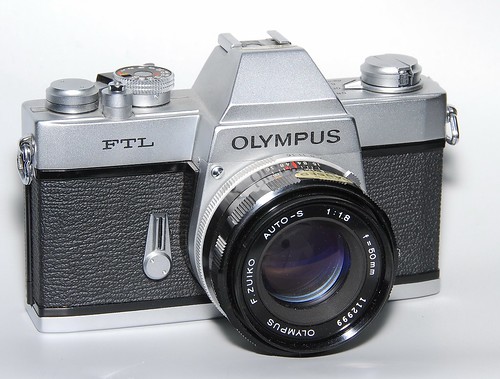 This was the Olympus FTL. It is a thoroughly ordinary manual only camera the same size and weight of other available cameras. They sell for good money to collectors, because they are relatively rare but are really a curious historical blip which remained in production for less than two years.
Then, in 1972, Olympus released their new camera, the OM-1. (In fact it was originally released as the M-1, but Leica, whose rangefinder cameras were designated as M, objected and Olympus settled on OM-1). The OM-1 measured just 136mm x 83mm x 81mm and weighs only 680g, with the standard 50mm f1.8 Zuiko lens. By comparison the Pentax Spotmatic was 143mm x 92mm x 88mm and weighed 868 grams with a standard lens. A small, light, superbly engineered, top quality camera came as a revolution.
The Cameras: Olympus
All Olympus SLRs of this era (with one exception …) have the same size and shape. There are two parallel ranges of cameras whose essential difference is build quality. Far and away the most common are the top level OM-1 and OM-2 and the much cheaper, but fabulously popular OM-10. Personally, I think the OM-1 and OM-2 are the perfect cameras to return to 35mm film photography. They are small and light, they are built superbly with real attention to engineering detail. The shutters just sound perfect. The point of choice is simply, do I need an automatic mode, so I can get the light setting right quickly (choose the OM-2) or am I doing this because I always want to consider my light settings (choose the OM-1).  The OM-10 is very, very cute, but is really an auto only camera (you can get an add on manual adapter), but it is a poor solution for manual mode and there are so many far better alternatives. Also, it is not remotely as well engineered as the OM-1 and 2, BUT, if auto is fine, they are very nice cameras. All OM cameras have a self timer (electronic on the OM-10, mechanical on the 1 and 2). The OM-10 had a fixed hot shoe, but the 1 and 2 have a removable hot shoe, which was sold as an add on extra. They are frequently left off the camera, so check if you want to fit a flash gun, but also notice that the top of camera can be marked by the rubber fittings of the hot shoe (and they are so beautiful, you would want to check!)
The other cheaper range models were the OM-20 (which had the manual mode properly built in and is actually the best one to go for as a good auto/manual camera, but sadly it does not look as cute). Then, the OM-30 which was an early auto-focus experiment, in that it had a focus assist system in the viewfinder with red arrows and a green dot to show you were in focus. You still had to turn the lens, though! This is my favourite of the two digit models as it is full auto/manual, has the weird focus assist and looks as cute as an OM-10. The downside is the 5 LR44 batteries it needs. Finally, the OM-40 which was auto/manual, plus a program mode. These are quite popular, but the black finish marks quite badly and many do not look very nice.
At the top end, the OM-1 and OM-2 developed as the OM-1N and OM-2N, but the differences are minute and not relevant (more sophisticated flash synchronisation and hence a different hot shoe). In the next series of models, the viewfinder was rearranged so that the metering was done with LCD panels instead of needle meters and hence had much more electronics. The OM-3 was very short lived and fabulously rare and therefore now seriously expensive and was a direct replacement for the OM-1 as a fully manual camera. The OM-4 was auto/manual and had different metering modes. Again, they can be expensive, but much less so (except the TI Titanium model) .  Also in this era is the OM-2SP (for spot program). This was a cheaper OM-4 with the same greater electronics design as the 3 and 4 and of course had spot metering and a program mode. The 2SP, 3 and 4 are all fabulous cameras, but are not the classic retro experience that you get from a 1 or 2.
The odd exception is the OM2000. Only collectors want one of these. They are weirdly overpriced considering Olympus didn’t make them at all. It was a version of the standard budget Cosina with an OM bayonet lens mount. It is a perfectly good camera, but an Olympus, it is not.
Old Olympus cameras are generally very reliable, although OM-10s can appear to have locked up. The trick is to fit new batteries, set the self and fire the shutter. Also, OM-1s and 2s have a common problem, where the foam rubber that holds the flash system in place internally can perish. This creates an acidic mess that etches into the pentaprism. When you look through the viewfinder you will see what looks like large patches of fungus, but it isn’t, instead it’s the missing silvering from the prism. This is a disaster and requires a new pentaprism, which is a major repair.
The Cameras: Pentax
The Asahi Optical company, makers of Pentax cameras had been the leader. The Spotmatic had brought through the lens metering (TTL) and ushered in the modern era. (Yes, I know the Topcon RE Super came to market first, but the Spotmatic was anounced first and did TTL the way everyone copied). However, it was only in 1975 that they released a new series of cameras. This was the K series. Essentially the same size, weight and body design as the Spotmatic, but with the new Pentax K bayonet mount for lenses. This ultimately became the most common lens mount with many smaller makers using it as well as Pentax. Even some modern Pentax DSLRs can still use K mount lenses. There were 4 models in the range. The top model, the K2 was auto and manual and had all of the extras. Next came the KX which was manual only but showed shutter speeds and aperture in the viewfinder, then came the KM which had a simple match needle in the viewfinder and a self timer. Finally, the cheapest was the K1000. Simple, manual only and absolutely no extras. And yet, it still commands a higher price second hand than any of the others, because its simplicity means it is recommended by photography course tutors to their students. The others were discontinued by 1980, but the K1000 remained in production until 1997, although later models were made with much cheaper materials in China.
However, it was clear Asahi had been working on the OM-1 threat and in 1976 just a year after the K series, they released the M series, which were the smallest and lightest SLR cameras yet. There were two models; the ME and the MX. They appeared similar, but in fact were utterly different. The ME was a direct competitor to the OM-10 having aperture priority auto mode only, but with better build quality.  The MX was manual only and competed with the OM-1 with excellent build quality and a clever viewfinder indicator of shutter speed and LED lights showing over, under and correct exposure. The MX is a lovely camera.
Three years later the ME was replaced by the ME Super. This was an enormous success. Great build quality, auto and manual modes, with LED lights to show shutter speed and push buttons to set the speed.  There were cheaper versions (MG, MV then MV1) which were all auto only and differed slightly in features like the self timer and flash modes. If you want an OM-10 alike for very little money, these are a good option. A version of the ME super called an ME-F was released with a focus assist system similar to the OM-30.
The ME super is a seriously lovely camera and would be my next choice after an OM-1 or 2. However, there is an important proviso. Most ME Supers do not work! When the camera is wound on, the shutter mechanism latches in place with a small hook arrangement. On M series (Not MX) the latch gets stuck through lack of use and the camera will endlessly wind on. This can be fixed, but is very hard and not for the faint hearted. So, only get an ME Super (or any other M or A series) if you can be sure that the shutter is firing. It will fire even without a battery if you set it to B or 125x (Flash) mode, so they can easily be checked.
Ultimately these were replaced by the Super A and Program A cameras which were very similar to each other and basically ME Supers in a black body with a program mode. These can be great value, but you must make sure to get an A series lens with it or the program mode will not work.
The final Pentax cameras in this era were the T30 and T50. These were designed to be cheap, and have much more plastic then the Ms, both were straight forward auto/manual cameras with LED viewfinder displays, but especially the T50 with its info panel and push button controls is a nice standard camera which can be had quite cheaply. Again, these need A series lenses for the auto mode to work.
In part 2, I will look at what Canon and Minolta were doing for the serious enthusiast photographer in this era when the SLR format became dominant.