I have been giving an overview of classic SLRs, by which I mean those from the start of TTL (through the lens metering, so you can set the light settings with information in the viewfinder) up to the start of the autofocus era. My main emphasis has been on small and light SLRs heralded by the arrival of the Olympus OM-1 in 1972. I started with the dominant consumer cameras from Olympus and Pentax, then looked at the dominant manufacturers; Canon and Minolta (although the number 1; Nikon will wait for later). In this post I will give an overview of everyone else.
In the immediate post (second world) war era, there was a huge quantity of different camera manufacturers in Germany and Japan, but also in the USA, UK, Italy, France and elsewhere. The USA was keen to prevent German manufacturers in West Germany working with their counterparts in the East (notably Carl Zeiss, makers of Contax cameras) and so used their influence in Japan to promote Japanese manufacturers. In East Germany all camera making was brought together into the VEB Pentacon brand (incorporating Carl Zeiss in Jena and Praktica cameras). The smaller West German brands struggled on, but famous names such as Rollei, Minox, Exakta, Voigtlander and Contax have all largely disappeared. Only Leica has survived as the definitive premium brand. So, the vast majority of cameras to consider are Japanese or East German and the main players were; Mamiya, Konica, Fujica and Praktica.
But first, let us deal with the smaller players. Rollei was a major brand. It is hard to see press photographers from the 1950s on without seeing a Rolleiflex twin lens reflex camera. However, by our era they were struggling. 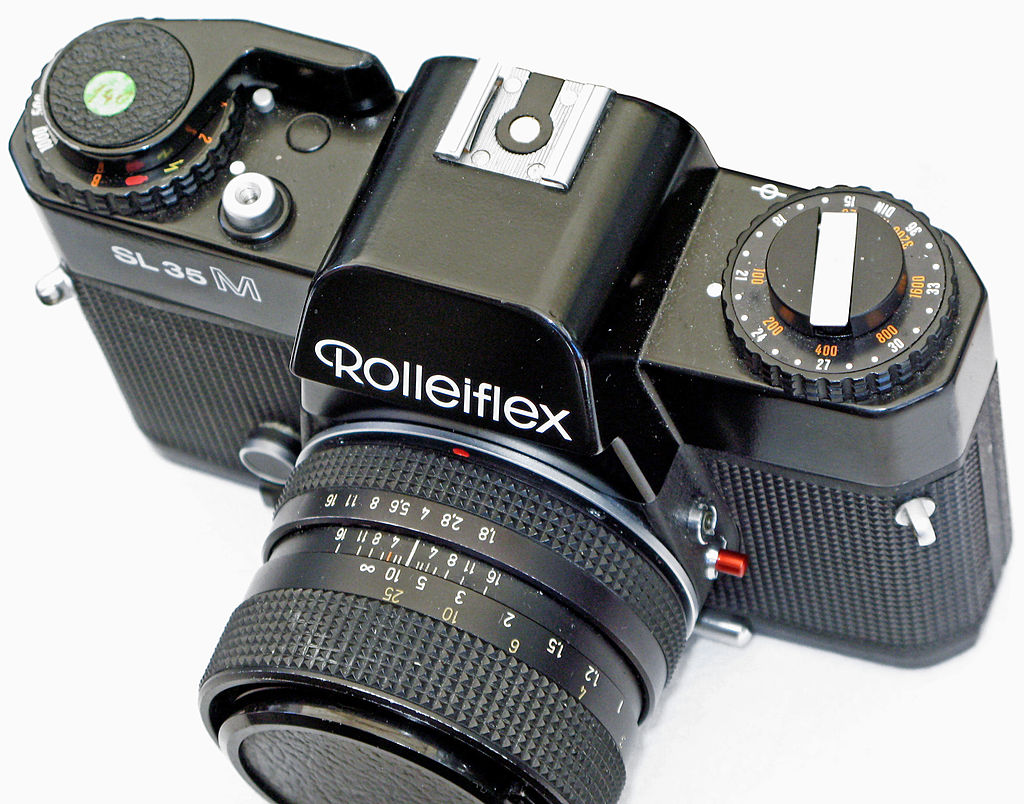 They built bulky but solid SLRs in the SL35, 350, 35M and 35ME and a neater smaller well specificied SL35E. They came with West German Carl Zeiss designed lenses and the SL35E is a nice camera. There is also a version with the Voigtlander name (the VSL35E) as Rollei owned that by then. However, it flopped and was sold off cheaply at the time. Now, because of the German connection they sell for quite high prices, which makes no sense.
Ricoh have always been major innovators and have survived to the present day. Indeed Ricoh now continue as owners of the Pentax camera brand. They always made good quality cameras designed to be very competitively priced but with a high specification.  They all had the common Pentax K mount for lenses. The best example is the Ricoh KR 10; an excellent auto/manual SLR with OM-10 level build quality. The KR series were replaced by the XR series, for example the XR-P is full auto/manual and program mode in a high quality body. Being less fashionable, Ricoh SLRs are always good value now.
Chinon operated in a similar way, being innovative and cheap(er) and again can be great value for money. The CP-X, for example is a very sophisticated auto/manual/program SLR in a well built small and light body, but with quite a lot of plastic.
Cosina make cameras for other people, generally. Notably the Canon T60, Olympus OM2000 and even Nikon FM10 were all made by Cosina. However, they were also many people’s entry into SLR with the cheap and chearful CT-1, a manual only camera with traffic light LEDs for over/under/correct light settings. They are great! Minimal build quality but fun and fine. There are more sophisticated Cosinas, but all are basically similar. The top CT-7 model was the world’s first all push button camera! Identical models were also branded as Exacta, Petri and Miranda, famous old names that had folded and been sold on. Most cheaper Chinon and Ricoh models are really Cosinas. The US distributor Vivitar had Cosina build a range of camera under their name. Look here for a long list of Cosina made cameras.
Mamiya remain as manufacturers of professional medium format film and digital cameras. They were innovative makers of SLRs until their distributor went bankrupt and they abruptly left the market. There are two distinct eras. The big, bulky, solid Mamiya/Sekor series with M42 screw fit lens mounts. The most notable being the 1000DTL which was the first (and for a long time, only) camera with both spot metering and center weighted average metering. These are great cameras, very well made and certainly an excellent choice if you are in the Pentax K, Minolta SRT or Canon F market. However, Mamiya then went for small and light with a dramatic shift to the NC1000s. I love this camera. It is superbly engineered with clever electronics and a sophisticated lens mount (Mamiya only). No-one seems to know about it, so they sell cheaply. However, Mamiya then changed the lens mount again and brought out the ZE (auto only – cheap), ZE-2 auto/manual, ZM auto/manual and very nice looking and ZE-X auto/manual/program. These last two are very attractive cameras but do not come up very often and prices vary.
Konica ultimately joined with Minolta in the digital era and died along with them, unless you are in the market for a photocopier that is. They have always been great design innovators and there are many striking Konica cameras in different formats. Again, we have two eras in SLRs.  The Autoreflex T series, which are in the Pentax K style. They have superb build quality and excellent lenses and are very stylish cameras. The Autoreflex T3 is generally held to be the best, but there are T, T2, T3 and T4. The TC was a late model designed to be cheaper. Unusually, the auto mode is shutter priority on all of these, so you set the shutter speed and it chooses the lens aperture for you.
Then the small and light range was headed by the stunning FT-1 which was full auto/manual with a built in motor drive in a very compact body. Many people consider this the prettiest SLR ever. I love mine! However, the motor and electronics have not lasted well and very few now being sold will still work. Get one with a guarantee! The FS-1 was the first SLR with a built in motor drive and these are more likely to work, the FC-1 was the same without the drive,  FP-1 was auto only with program mode and the FC-X was the cheapy (made, of course by Cosina). The FS-1 and FC-1 are very nice cameras depending on whether you want the built in (and hence noisy) motor driven wind on. They are both auto/manual with aperture setting LEDs in the viewfinder.
Fujica are the largest manufacturer of imaging products in the world. They remain a major player in the photography market and make innovative cameras slightly off the mainstream, as they always have. Fuji stuck with M42 screw mount lenses longer than almost everyone else, incorporating methods for the lens to pass aperture information to the body for proper auto metering. So, there are two eras for Fuji; M42 and bayonet mount. Fuji did not make professional SLR cameras, so their build quality was never at the top end, more in the OM-10 to Pentax M series range. But they are all nicey designed and attractive cameras. The ST range are the most sophisticated M42 cameras ever made. The top model, the ST-901 had a LED digital readout in the viewfinder with full auto and manual modes. The ST-801 is similar but manual only and the ST-601 and 701 are both manual only with conventional needle metering. (Replaced by the ST-605 and 705 with little difference). In size terms these are Pentax K size although the ST-901 is certainly a very neat example.
The smaller lighter series came with a new Fuji only bayonet lens mount.  First there was the AX-5 (auto/manual full featured), AX-3 (auto/manual), AX-1 (manual only) all of which are very attractive cameras. The AX-5 is really nice and can be a great bargain as it is not well known. The era finished with low cost cameras; the STX-1 (manual only, but a very nice camera) and the STX-1N and STX-2 which look as they were, quite cheap.
Finally, we come to Praktica. There are many collectors who have catalogued the vast array of different Praktica cameras. Just see this example to whet your appetite. In general for my era, we have two sets to consider. Cameras with M42 screw mounts, which all have very similar bodies and vary in terms of the build and component quality. Also, Praktica were first to have electronic transfer of data from the lens to the camera body, so some of this type are Pentacon Electric, clearly seen by the three large contacts on the lens mount and the lens. To make this work you need a Pentacon electric lens. All are manual only with a match needle manual meter. Later series used a Praktica only bayonet lens mount. These are smaller and lighter and have much more plastic, but decent electronics and LED light displays. In general, Praktica bodies sell for very low prices. They were made in vast quantities and are not very fashionable, although with a sheepskin coat and courderoy trousers you can get the full 70s or 80s feel. This means they are great value, because the best made versions are really good cameras. Make sure to get a matching lens; they will be branded either Pentacon, Carl Zeiss Jena or Meyer Gorlitz. Whichever of these you get they were all developed from excellent classic German designs and the lenses are always worth more than the camera body.
The LTL, LTL2, LTL3 and later MTL3 then MTL5 are the classic good quality non-Electric models. 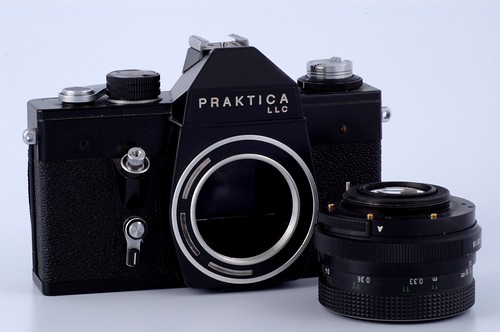 The LLC was the first Electric and is a very nicely made camera (the PLC, PLC2 and PLC3 were later developments but little changed). The top model was the VLC (later VLC2 and VLC3) which are also electric but have interchangeable viewfinders and so you can change from eye level viewing to a waist level finder and others. They are great fun to collect. VLCs are the only Prakticas that command noticeably higher prices.
The bayonet mount series are either B or BX series. Again with little difference, but automatic only, manual only or auto and manual signal the key differences. The B200 is a classic auto/manual, while the top BCX is a very smart full featured camera with nice build quality and virtually the only one that came in chrome finish. The BX series show that the end was nigh and are quite cheaply made.
So, if you have reached this point, my survey of what I am calling classic era SLRs is over, unless you want a Leica, a Contax or a Nikon that is, but then, they are not cheap …