The Single Lens Reflex (SLR) camera is the most common way to get started in film photography. The camera itself has a removable lens, so without the lens it is referred to as the camera body. This means that for a given body there is normally a large number of available lenses. This article will look mainly at camera bodies, but I’ll start with an overview on lens issues.
To choose your lens, you must first make sure that the lens will fit your body. This requires it has the correct lens mount. You will need to know the lens mount on your camera body. There are a vast range of options, but in general, most manufacturers produced lens mounts specific to their cameras. Many of them changed these mounts over time and older cameras and more recent ones by the same manufacturer are not compatible (For example Canon AE-1 cameras and Canon EOS cameras have a completely different lens mount). Sometimes, extra features were built in, so a lens will fit, but will not do everything (e.g. Pentax-M lenses fit onto Pentax-A cameras, but the program mode will not work). Look at the wikipedia lens mount article just to see how complex this is. The most universal systems were the 42mm screw fit lenses (M42) used on a large number of cameras up to the 1970s (Pentax, Praktica, Fujica, etc.) and the Pentax K mount (Later Pentax, Ricoh, Cosina, Chinon, etc.). Then you need to decide between zoom lenses, which have a range of different focal lengths (how wide the view is) or prime lenses which have a fixed focal length. Zoom lenses are not fashionable, they tend to big and bulky, but excellent compact zooms can be very cheap. New users prefer the simplicity of fixed lenses and a standard set up would be to have a 50mm lens, a wide angle lens (28mm is most common) and a telephoto (135mm is a nice small standard).
So, which camera (body) is right for you? There are a series of broad phases in SLR development. It starts after the second world war, when German and Japanese manufacturers began bringing out SLR cameras which would have a dial to set the shutter speed and a lens with aperture control. They would have no light meter (you would buy a separate handheld light meter). You would have a viewfinder at eye level (i.e. you hold the camera up to your face – which became the standard) or one at waist level (you held your camera at your waist and looked down). Waist level finders were the standard with twin lens reflex (like the Rolleiflex) and were very popular in the 1950s, but became very uncommon on SLRs. 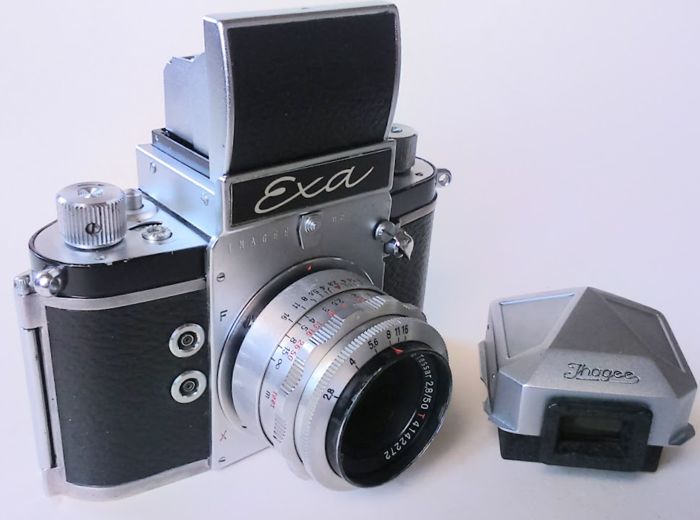 A number of cameras of this era (and indeed all professional cameras up to the end of the film era) had interchangeable viewfinders. (e.g. Exacta Exas, Praktica VLC, Topcon Super D and RE Super, Soligor, Miranda, etc.). You could get eye level finders, waist level finders and finders with built in light meters (like the classic Nikon F photomic finders). These are great fun and many of these are not expensive. Some cameras of this era had a light meter built in to the camera body, but worked like a handheld one and was simply a guide to settings. (For example the Canon Canomatic R).
The next phase had the light meter built in, taking light through the lens (TTL). You still only had control over shutter speed and aperture, but now you could see in the viewfinder if the light was correct. The Topcon RE-Super was first and these are quite expensive and relatively rare, but the Pentax Spotmatic was just after and these are inexpensive and common. The Pentax has a gorgeous lens (named Takumar) and comes in a variety of versions. 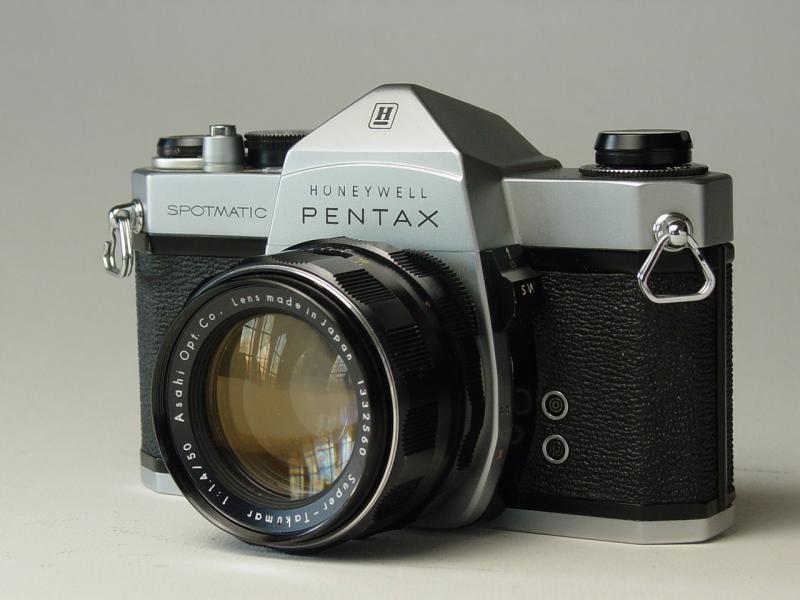 The first is just the SP, then there was an SP1000 and SP500 (indicating their fastest shutter speed), SPII, F and more (see wikipedia). The differences are very subtle (e.g. range of shutter speed, inclusion of a self timer, flash sockets, … nothing major). These are perfect big, solid, heavy, reliable cameras.
The next phase was a fundemental shift in size. Most SLRs were large and heavy (around 1 kg with the lens). Then Olympus brought out the OM-1. This had all the facilities of other cameras but in a package that was much smaller and fitted the hands perfectly. An OM-1 with the standard zuiko 50mm f1.8 lens is 680g. To me this is the perfect all manual SLR. It is beautifully made, looks beautiful and has a shutter which you would record for your phone shutter – just perfect. You would get an OM-2 if you want an auto mode in essentially the same camera. Pentax brought out their M series cameras very soon afterwards. These were a very similar style, size and weight. The all manual MX is a good alternative to the OM-1 and is also superbly built. The ME, ME-super and other varients are lower quality cameras built to a different price point and should not be compared.
Next there were increasing levels of automation of the metering systems with AP, SP and program modes. Cameras with manual and one auto mode are very common.
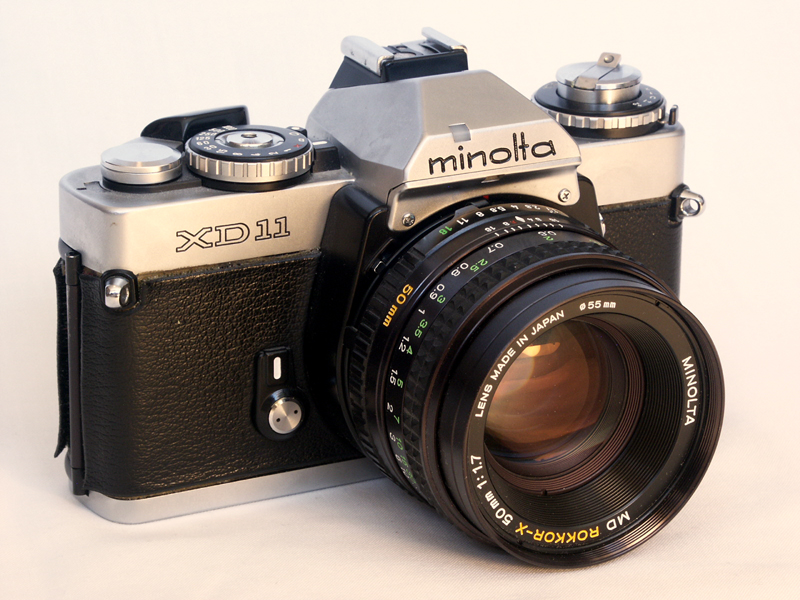
The first camera with manual, AP and SP was the Minolta XD7 (called XD11 in the US). This is an OM-1 quality camera, small and light with a gorgeous shutter. It also looks the part perfectly. My go-to SLR is the XD7’s replacement, the Minolta X-700 which also has a program mode and is beautifully built.
Finally, there came autofocus that worked. The earliest proper AF SLRs looked like the 1980s they came from and are of historic interest only. However, with the Canon EOS film cameras, the Nikon F series and Minolta Alpha cameras, very high quality cameras looked nice and worked well. Get a Minolta Alpha 5 plus a lens for about £30 and you have an amazingly sophisticated camera. (The alpha 7 and 9 are highly prized professional level cameras). You just have to be OK with plastic.
That is my overview of the key points of choice for an SLR camera (body). My next SLR post will focus more deeply on specific manufacturers and their camera ranges.